How The System Helps You Succeed
Introducing high-value services into a clinical practice often presents challenges that go beyond clinical knowledge. Many practices have the capability to deliver services such as peptides or regenerative medicine, but struggle with consistent implementation, patient communication, and long-term follow-through.
These challenges can limit patient engagement, reduce treatment acceptance, and prevent services from reaching their full potential within the practice.
Why Many Practices Struggle to See Results
In many cases, practices attempt to implement new services without a structured system in place. This often leads to inconsistent communication, unclear patient expectations, and gaps in follow-up.
Without alignment between clinical delivery, patient education, and operational workflows, even well-designed services can fail to produce consistent results.
A System That Supports Clinical and Operational Success
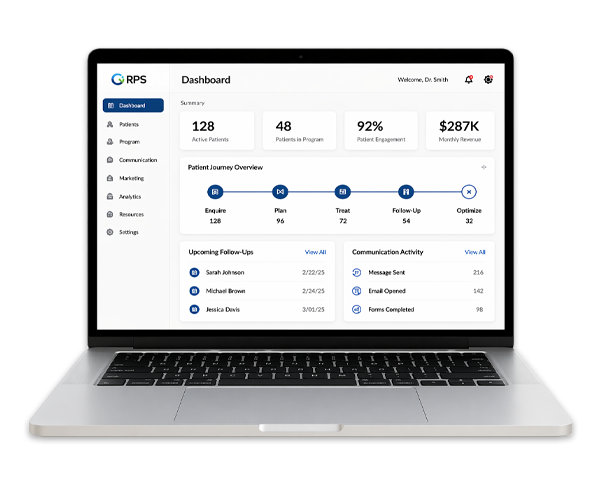
The RPS System addresses these challenges by providing a structured environment in which each component of care delivery is supported. Rather than relying on individual staff members to manage multiple processes, the system creates a coordinated approach that improves consistency across the practice.
- Patients receive clear and consistent information about their care
- Communication is maintained throughout the treatment process
- Teams follow defined workflows rather than ad hoc processes
- Care delivery becomes more predictable and repeatable
Improving Patient Understanding and Engagement
Patient understanding plays a critical role in treatment acceptance and long-term outcomes. When patients have a clear understanding of their condition, treatment options, and expected results, they are more likely to engage in care.
The system supports this by providing structured education and communication that reinforces key information at each stage of the patient journey.
Reducing Operational Complexity
Many practices attempt to address operational challenges by adding staff or implementing multiple software tools. While this can provide short-term solutions, it often introduces additional complexity and increases overhead.
The RPS System reduces this complexity by consolidating essential functions into a single platform. This allows practices to operate more efficiently without expanding their team or relying on multiple disconnected systems.
In many cases, this approach replaces the need for multiple roles related to communication, follow-up, and coordination.
Supporting Consistent Patient Follow-Up
Consistent follow-up is essential for maintaining patient engagement and improving outcomes. However, manual follow-up processes are often inconsistent and dependent on staff availability.
The system addresses this by automating communication workflows, ensuring that patients receive timely and consistent follow-up throughout their care.
Enhancing Retention and Long-Term Value
Long-term patient retention is influenced by both clinical outcomes and the overall patient experience. When patients feel informed, supported, and consistently engaged, they are more likely to continue care and return for additional services.
The structured approach provided by the system supports these outcomes by maintaining continuity of communication and care delivery.
Creating a More Predictable Growth Model
Without a defined system, practice growth can be inconsistent and difficult to manage. Variability in communication, workflow execution, and patient engagement can lead to unpredictable results.
The RPS System introduces a level of structure that allows practices to operate more predictably. By standardizing key processes, the system supports more consistent performance across all aspects of service delivery.
Built for Real-World Practice Environments
The system is designed with the realities of clinical practice in mind. It supports providers and staff without adding unnecessary complexity, allowing teams to focus on delivering care rather than managing processes.
This practical approach ensures that the system can be implemented and maintained over time, supporting both immediate improvements and long-term success.
A More Efficient Path to Growth
By aligning clinical delivery, patient communication, and operational workflows, the system creates a more efficient and effective approach to implementing high-value services.
This results in improved patient engagement, more consistent outcomes, and a stronger foundation for long-term practice growth.