 How The System Helps You Succeed
 What’s Included in the System
 How Implementation Works
 Why A Structured System Matters
 Real Practice Outcomes
 Creating a Profitable Practice
 Patient Demand
  Patient Education
  Staff Education
  Marketing
  Regenerative Medicine Platform
 Franchise & PE Support
  Wharton’s Jelly
 Exosomes
 Anti-Aging
 Aesthetic Treatments
 Neurological
 Autoimmune
 Wound Care
 Orthopedic Conditions
 Clinical Trials
 Articles
 Research Institutes
As regenerative medicine continues expanding across chiropractic, wellness, orthopedic, functional medicine, and integrative healthcare practices, more providers are exploring advanced biologic therapies involving exosomes, Wharton’s Jelly, MSC-derived products, and other regenerative medicine applications.
At the same time, patient awareness surrounding regenerative medicine has grown rapidly. Many patients now actively search for non-surgical alternatives designed to support recovery, joint health, mobility, wellness optimization, and long-term function.
One of the most common questions patients ask providers today is:
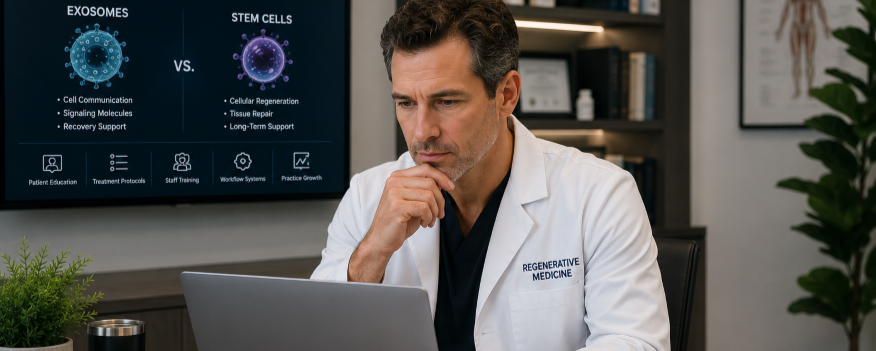
“What’s the difference between exosomes and stem cell-based therapies?”
Although these therapies are often discussed together online, they are not the same. Understanding the differences is important not only for patient education, but also for practices looking to build more organized and professional regenerative medicine programs.
At Regen Practice Solutions (RPS), we help practices implement regenerative medicine services through provider education, staff training, patient communication systems, onboarding workflows, and operational support designed specifically for clinics adding high-value wellness and regenerative treatments.
Why Regenerative Medicine Continues To Grow
Many healthcare practices are seeing increased demand from patients searching for non-surgical wellness and recovery-focused treatment options. Patients today are often looking for alternatives that may help support mobility, performance, joint function, recovery, and long-term wellness without invasive procedures.
As interest in preventative health, longevity medicine, and biologic therapies grows, regenerative medicine has become one of the fastest-expanding areas within modern wellness-focused healthcare.
Practices are increasingly exploring regenerative services because they can help support:
- Expanded wellness offerings
- Long-term patient relationships
- Higher patient engagement
- Cash-based revenue opportunities
- Non-surgical treatment programs
- Recurring patient visits
However, many providers quickly discover that implementing regenerative medicine successfully requires significantly more structure than simply offering treatments.
What Are Exosomes?
Exosomes are small extracellular vesicles involved in cellular communication. They contain signaling molecules such as proteins, growth factors, lipids, and other biologically active materials that help cells communicate with one another.
Within regenerative medicine discussions, exosomes are commonly associated with cellular signaling and communication-based applications.
Many providers exploring regenerative medicine discuss exosomes within programs focused on:
- Recovery support
- Joint and mobility wellness
- Performance optimization
- Wellness-focused regenerative strategies
- Advanced biologic applications
As patient interest continues growing, more practices are looking for ways to better educate patients on how these therapies fit into broader regenerative wellness programs.
What Are Stem Cell-Based Therapies?
The term “stem cell therapy” is often used broadly online, even though regenerative medicine today includes many different biologic and MSC-based applications.
Practices commonly discuss therapies involving Wharton’s Jelly, MSC-derived products, amniotic-derived materials, and other biologic therapies as part of regenerative medicine programs.
These therapies are frequently explored within practices focused on non-surgical wellness, recovery support, and advanced regenerative medicine services.
As regenerative medicine continues evolving, many clinics are shifting toward more structured patient education and implementation systems designed to help patients better understand available regenerative options and overall program expectations.
The Difference Between Exosomes and MSC-Based Therapies
One of the simplest ways to explain the difference is this:
Exosomes are primarily associated with cellular signaling and communication, while MSC-based therapies involve biologic materials commonly discussed within regenerative medicine applications.
Although these therapies are different, they are frequently discussed together because many regenerative medicine clinics explore both categories as part of broader wellness and recovery-focused programs.
Patients are often confused by regenerative terminology online, which is why provider communication and patient education become extremely important when implementing these services within a practice.
Why Provider & Staff Training Matters
One of the biggest challenges many practices face when adding regenerative medicine services is provider and staff confidence.
Even clinics interested in offering advanced biologic therapies often feel overwhelmed by:
- Patient questions
- Consultation consistency
- Regenerative terminology
- Program implementation
- Staff coordination
- Patient communication expectations
Without proper systems in place, providers often spend large amounts of time repeating explanations manually during consultations while staff members struggle to maintain consistency throughout the patient experience.
That is why structured training and implementation systems become critical for long-term success.
The RPS platform helps practices simplify regenerative medicine implementation through provider education, staff onboarding systems, patient communication tools, workflow support, and operational guidance designed specifically for modern regenerative medicine clinics.
Patient Education Often Determines Program Success
Many patients researching regenerative medicine are unfamiliar with the terminology surrounding exosomes, Wharton’s Jelly, MSC-derived products, and other biologic therapies.
Patients commonly ask:
- How do exosomes work?
- What is Wharton’s Jelly?
- What are MSC-based therapies?
- How are regenerative therapies different?
- What should patients expect during care?
Practices without strong education systems often experience lower patient confidence, inconsistent communication, and weaker long-term retention.
RPS helps clinics improve the patient experience by providing structured education systems that help practices communicate regenerative medicine programs more clearly and consistently.
Why Operational Systems Matter As Clinics Grow
As regenerative medicine services expand, many clinics quickly encounter operational bottlenecks involving patient communication, lead management, onboarding, scheduling, retention, and workflow coordination.
Without structure, regenerative medicine programs can become difficult to scale efficiently.
Many practices eventually realize they need organized systems for:
- Lead follow-up
- Patient onboarding
- Communication workflows
- Retention management
- Scheduling coordination
- Staff organization
RPS was built specifically to help practices centralize these systems into one connected platform designed for regenerative medicine implementation and long-term scalability.
Building A More Structured Regenerative Medicine Program
Successfully implementing regenerative medicine services requires much more than simply offering treatments. Long-term success depends on provider education, staff training, patient communication, workflow consistency, onboarding systems, and operational structure.
Regen Practice Solutions helps practices build more organized regenerative medicine programs through one connected platform that includes implementation guidance, provider education, patient education systems, workflow automation, retention support, and operational management tools designed specifically for modern healthcare practices.
Whether a clinic is exploring exosomes, Wharton’s Jelly, MSC-based therapies, or broader regenerative medicine services, the RPS platform helps providers and staff implement these programs with greater structure, consistency, and long-term scalability.
Book a demo to see how Regen Practice Solutions helps practices implement regenerative medicine services with training, education, workflows, and operational support designed for long-term growth.